St. Martin’s Cathedral Bratislava | Coronation Church of Hungarian Kings
A short history of St. Martin’s Cathedral
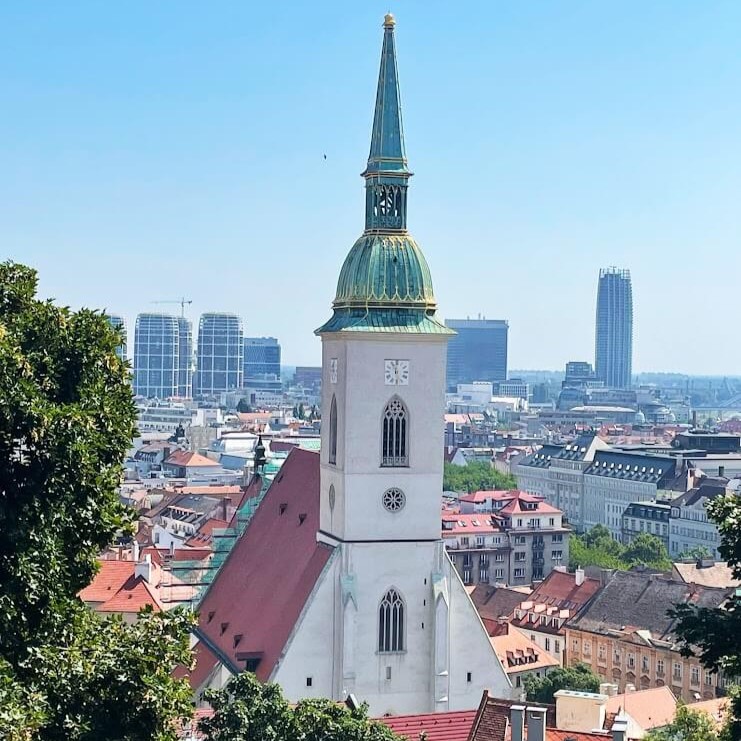
St. Martin’s Cathedral is Bratislava’s most important church and a masterpiece of Gothic architecture. For nearly 300 years (1563-1830), this magnificent cathedral served as the coronation church of the Hungarian Kingdom, where 11 kings and 8 royal consorts were crowned.
The cathedral’s history dates back to 1221, when Provost requested Pope Honorius III permission to relocate the capitular church from the Castle to the city. Works thus began in the 13th century on the site of the former cemetery chapel of St. Martin to build a church of the Sacred Saviour. As the new church proved too small, construction of the present Cathedral began in 1320.
The Coronation Era (1563-1830)
Nonetheless it was the older dedication to St. Martin that remained attached to the Cathedral. The church was consecrated in 1452, though the construction of the presbytery continued until 1487. In 1563 the Cathedral became the coronation cathedral of Hungarian monarchs and served the purpose until 1830. There have been crowned at St. Martin’s cathedral 11 Hungarian kings and queens and 8 wives.
- Maximilian II. on 08.09.1563, his wife Mary on 09.09.1563
A tolerant ruler sympathetic to Protestants, he played a key role in maintaining religious peace in his lands. He died at the Imperial Diet in Regensburg, where he urged princes and estates to unity, order, and harmony. - Rudolf on 25.09.1572
A patron of the arts and sciences, he was a leading collector and supporter of Italian and Dutch painters. He lived in Prague and had interests in magic, alchemy, and astrology. Later in life, he suffered from depression and paranoia. - Matthias II. on 19.11.1608, his wife Anne on 25.03.1613
The younger, ambitious brother of Emperor Rudolf seized power with the support of Hungarian, Austrian, and Moravian estates. He brought the Hungarian coronation jewels from Rudolf’s collection back to Hungary and placed them in the Crown Tower at Bratislava Castle. - Ferdinand II. on 01.07.1618, Eleanore, his second wife on 26.07.1622
Crowned King of Hungary at 13 and later King of Bohemia, he was involved in royal duties from a young age by his father, Emperor Ferdinand III. At 20, he was elected King of Germany and was set to marry the eldest daughter of Spain’s King Philip IV, but he tragically died of smallpox that same year, in 1654. His father mourned the loss of his beloved son deeply. - Ferdinand IV. on 16.06.1647
Crowned King of Hungary at 13 and later King of Bohemia, he was involved in royal duties from a young age. Elected King of Germany at 20 and engaged to the eldest daughter of Spain’s King Philip IV, he tragically died of smallpox the same year, in 1654. His father, Ferdinand III, deeply mourned his loss. - Leopold I. on 27.06.1655
A key rival of Louis XIV, he defended the Holy Roman Empire, secured the Hungarian crown for his family, and aimed to place his son Charles on the Spanish throne. Married three times, he had 16 children. - Joseph I. on 09.12.1687
Crowned at 9, he was exceptionally talented, especially in music, with perfect pitch. Without imperial duties, he might have become a second Mozart. He supported his brother’s fight for the Spanish throne and planned many reforms, which were never realized due to the war with France. He died of smallpox at 33. - Charles III. on 22.05.1712, his wife Elisabeth Christine on 18.10.1714
At 18, he went to Spain to fight for the Habsburg inheritance. After the deaths of his father and brother, he became the last male Habsburg and returned to Vienna. Spain passed to the Bourbons, and his subsequent policy focused on enforcing the Pragmatic Sanction, ensuring his daughters could inherit the undivided Habsburg monarchy. - Maria Theresa on 25.06.1741
She ascended the throne at 23 and, despite being seen as a weak ruler by European monarchies, preserved the integrity of her empire. After the wars over the Austrian succession, she implemented major reforms: compulsory education, public health initiatives including vaccination, army organization with uniforms and regular pay, judiciary reforms banning witch burning, and financial reforms with paper money and balanced budgets. Together with her husband, Francis Stephen of Lorraine, she had 16 children. - Leopold II. on 15.11.1790
The second son of Maria Theresa, he continued the enlightened reforms of his mother and brother, Emperor Joseph II. As Grand Duke of Tuscany, he is best known for his criminal code: abolishing the death penalty, torture, and imprisonment for debt, reducing sentences, and ending the criminalization of insulting the monarch. Together with his wife, Maria Ludovika of Bourbon, they had 16 children. - Ferdinand V. on 28.09.1830
Known as “the Kind,” Ferdinand believed in ruling with benevolence. He abdicated in 1848 in favor of his nephew Franz Joseph I and spent his remaining years in seclusion at Prague Castle.
From 1000 to 1563, Hungarian kings were crowned in Stoličný Belehrad (today’s Székesfehérvár).
From 1563 to 1830, Bratislava became the coronation city, with a few exceptions:
- Eleonóra, second wife of Ferdinand II – crowned in Sopron, 26 July 1622
- Ferdinand III (1637–1657) – crowned in Sopron, 8 December 1625
- Eleonóra Magdaléna of Pfalz-Neuburg, third wife of Leopold I – crowned in Sopron, 9 November 1681
- Francis I (1792–1835) – crowned in Buda, 6 June 1792
Joseph II (1780–1790) refused coronation, considering it an outdated ritual.
From 1830 onward, only a few coronations took place:
- Franz Joseph I (1848–1916) and wife Elisabeth of Bavaria – crowned in Buda, 8 June 1867
- Charles IV (1916–1918) – crowned in Budapest, 21 November 1916
- Zita, wife of Charles IV – crowned in Budapest, 30 December 1916
Architecture & Gothic Style
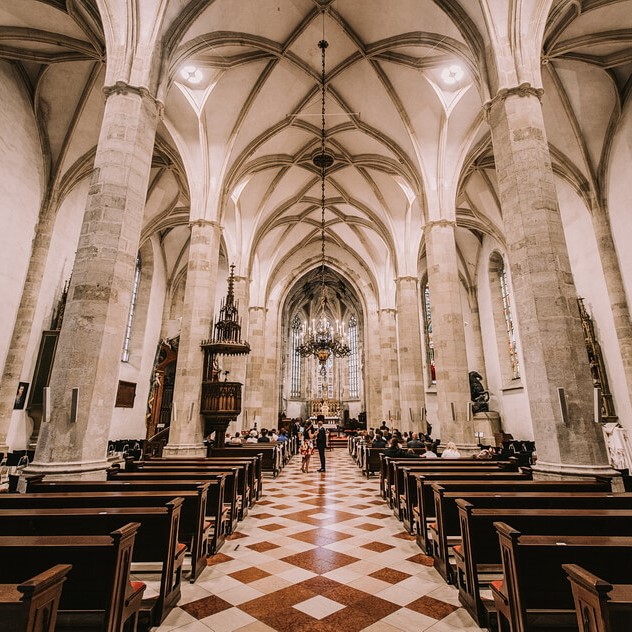
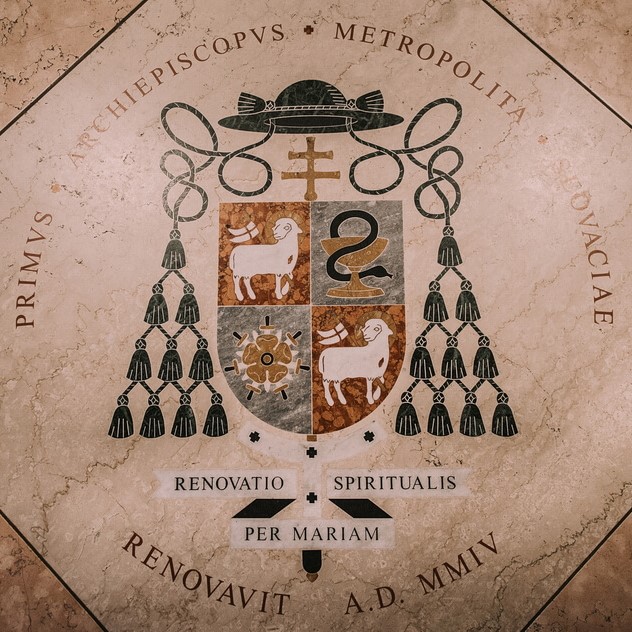
In the 18th century the Archbishop of Esztergom, Emeric Esterhazy invited Baroque artists led by Georg Rafael Donner to carry out Baroque reconstruction of the Cathedral. In the next century, however, the church regained its original Gothic style. Since 2008 St. Martin’s Cathedral is the cathedral church of the Bratislava Archdiocese.
St. Stephan’s Crown at St. Martin’s Cathedral
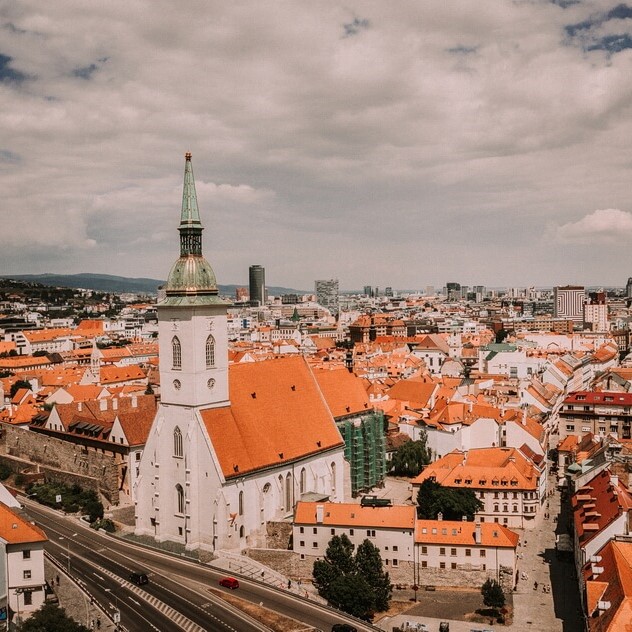
The spire is topped by a true rarity, the 1.6 metres tall gold plated replica of Hungarian Royal Crown. It is placed on a square cushion with sides measuring 1.2 metres in length and 0.5 metres in height. The piece weights 150 kg. The crown is a reminder of the illustrious coronation era of the cathedral.
St. Martin’s Cathedral Bells
During the First World War the five old bells of St. Martin’s Cathedral in Bratislava were removed and melted to be converted into cannons. Only one bell, Wederin, proved impossible to remove because of its weight of 2.5 tons. Made in 1674 it is one of the five most treasured bells in Europe. Five bells were returned to the spire in 2000 as a gift from the capital cities of the neighbouring countries. The largest bell, weighing 2.2 tons, comes from Austria. The bells announce noon on Sundays via the Slovak Radio. The cost of the remaining two bells was covered from public donations among churchgoers.
St. Martin’s Tower
At its top, at a height of 85 meters, there is a model of the Hungarian royal crown, weighing 150 kg and measuring 164 cm in height. It is a symbol of the coronation church.
The miracle of Bratislava
Strange things started to happen after the death of one of the Bratislava burghers, Hans Klement Zwespenbauer. His spirit allegedly appeared recurrently between 24 June 1641 and 29 June 1642 to the pious Regina. He asked her to request from his widow 200 golden coins which, when alive he had stolen in a robbery which eventually led to murder. He was not allowed to enter the Purgatory for he didn’t believe the revelations. The spirit was demonstrating its authenticity by leaving burned imprints of hand on drapery or trunk.
The Archbishop Emeric Losy set up a committee to investigate the case. Provost Michael Kopcsanyi was the first to make a written report of the event. Regina’s testimonies were confirmed by 32 sworn witnesses. Meanwhile, the sculptor George Scheilbel made the statue of Piety. He was allegedly guided by Hans’s spirit which kept explicitly suggesting how and from which wood to carve the statue. The completed work was transferred to the St. Martin’s Cathedral in Bratislava on 29 June 1642.
Prior to that people saw white dove fly up. It was a sign that Hans was forgiven. The statue of Piety is still part of the Altar of Our Lady of Sorrows in the southern Nave. Regina’s opponents, however argued that her testimony was a fiction and decided the statue of Piety was a wooden devil.
Entrance fee to St. Martin’s Cathedral Bratislava
💰Cathedral admission information:
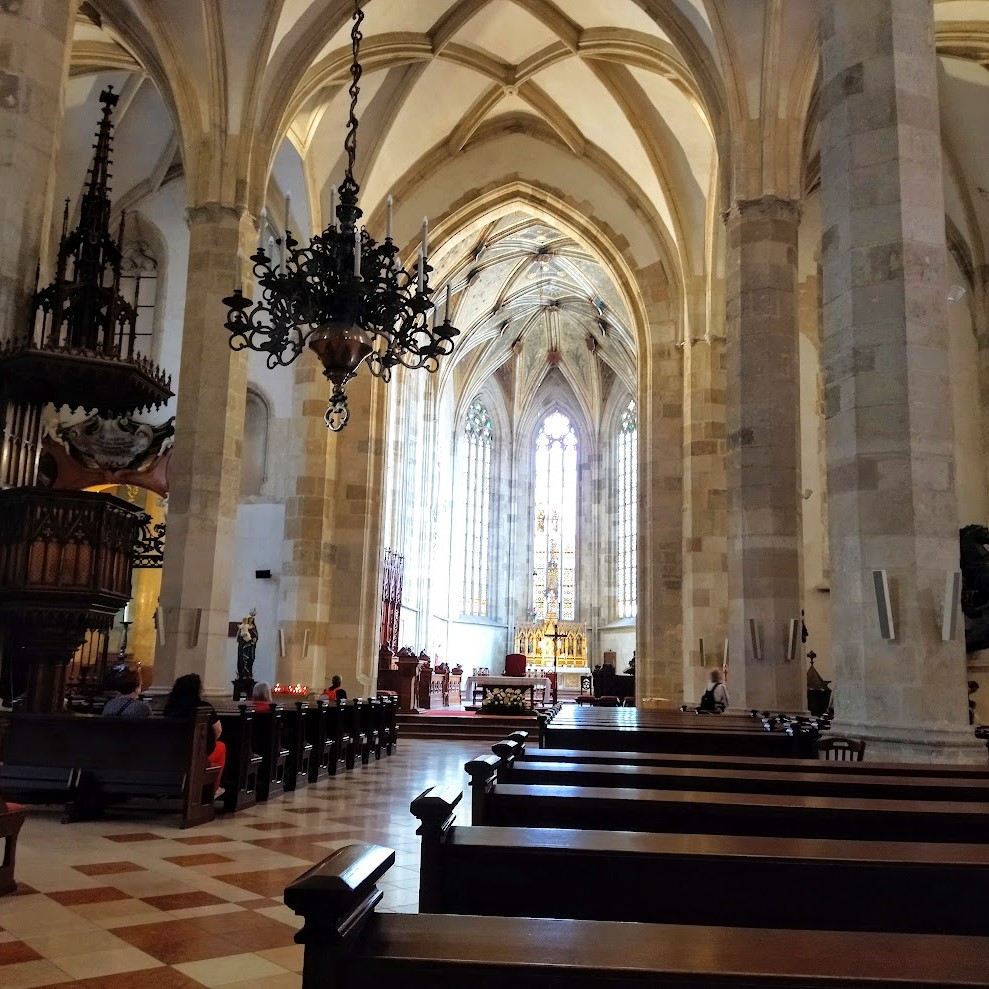
The cathedral is divided into two zones for visitors:
- Free-access zone: Includes the main nave for pilgrims, St. Anne’s Chapel, and St. John the Almsgiver’s Chapel.
- Tourist zone (€4.20): Includes the presbytery, the treasury (middle sacristy, Canons’ Chapel, and upper-level treasury), and the left part of the choir. (See diagram for reference.)
Reduced rates:
- Children under 15 and visitors with severe disabilities enter for free.
- Students up to 26 years pay €2.

Opening Hours & Holy Mass Timetable – St. Martin’s Cathedral 📅⛪
Monday – Friday:
from 09:00 am – 11:30 am & 01:00 pm – 06:00 pm
Saturday
09.00 am – 11.30 am (in the afternoons, wedding ceremonies usually take place, and tourist visits are not possible)
Sunday
01:45 pm – 04:30 pm
Timetable of Holy Masses at St. Martin’s Cathedral
Sunday:
09:00 am in Latin
10:30 am in Slovak
12:00 pm in Slovak (Parish holy mass)
05:00 pm in Slovak
Monday – Saturday:
07:30 am in Slovak
12:00 pm in Slovak
Public Holidays (Holy Days of Obligation):
09:00 am in Latin
10:00 am in Slovak (celebrated by Archbishop of Bratislava)
12:00 pm in Slovak (Parish holy mass)
05:00 pm in Slovak
Non Public Holidays (Holy Days of Obligation):
07:30 am in Slovak
12:00 pm in Slovak
05:00 pm in Slovak (celebrated by Archbishop of Bratislava)
FAQ – Frequently Asked Questions about St. Martin’s Cathedral
Free access to the main nave; €4.20 for the full tourist zone.
Monday-Friday: 9:00-11:30 & 13:00-18:00
Allow 30-45 minutes for a complete visit.
Yes, photography without flash is allowed.
Visit St. Martin’s Cathedral with Us
Discover the coronation church of Hungarian kings on our guided walking tour of Bratislava. Our expert guides will bring the cathedral’s 800-year history to life. Book our 2 hour walking tour with Castle Ticket Tour!