Jewish Bratislava
Jewish Bratislava Tour – History, Heritage & Hidden Stories
Jewish Bratislava reflects the vital role that the Jewish community played in the history of the Slovak capital. The first written sources to mention Jews come from 13 century. At the time Jews lived along the street Uršulínska ulica. The city privilege from 1291 made Jews equal to the other inhabitants of Bratislava. Fearing the Turks, a number of Jews fled the city in 1526. Others we expelled from the city because of a decision of Queen Mary, the widow of Louis II, of 9 October 1526, on the grounds of alleged treason. Queen Mary ordered the Jews to be sold and to use the acquired money to enhance the city fortification. When exceptions were issued at the end of 16th century, Jews were allowed to settle in the area beneath the Castle.
In 1918, when the Czechoslovak Republic was founded, Jews were guaranteed equality and the status of an ethnic minority, although the overwhelming majority of Jews were not loyal to the new state.
Wilson City
The Jews took part in an initiative to transform Bratislava, which was still known as Pressburg at the time, into a city-state similar to Singapore or Monaco. The city was supposed to be named after the U.S. President Woodrow Wilson. Jews joined Hungarians and Germans who wanted to proclaim a “free city.”
On 18 January 1919, Bratislava was declared the capital of the Slovak part of Czechoslovakia. At the request of Vavro Šrobár, the minister with full powers for the administration of Slovakia, the city’s name was officially changed from Pressburg to Bratislava.
II. World War and Jewish Bratislava Catastrophe
At the time of the “birth” of Slovakia, Jews accounted for about 10% of Bratislava’s total population. The wartime Slovak state brought tragedy to Jewish population. Most Jews were deported to concentration camps and most of the few who remained alive, emigrated after the war.
Today, Bratislava is the only city in Slovakia with a vibrant Jewish community. Its members are actively engaged in social services, educational and cultural activities, while striving to reconnect with the illustrious history of the Jews of Bratislava.
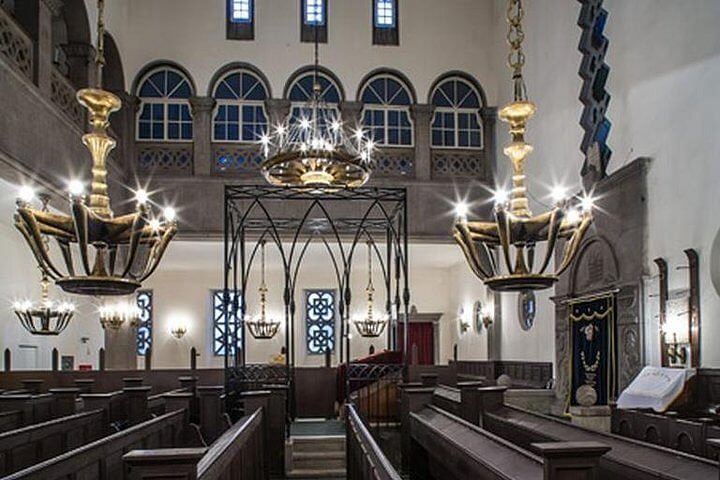
The walk begins at the Chatam Sofer Memorial. One can take a tram back to the city center, although it is far more interesting to walk back along Žižkova Street or along the riverbank. The route continues through Židovská Street and ends at the synagogue on Heydukova Street.
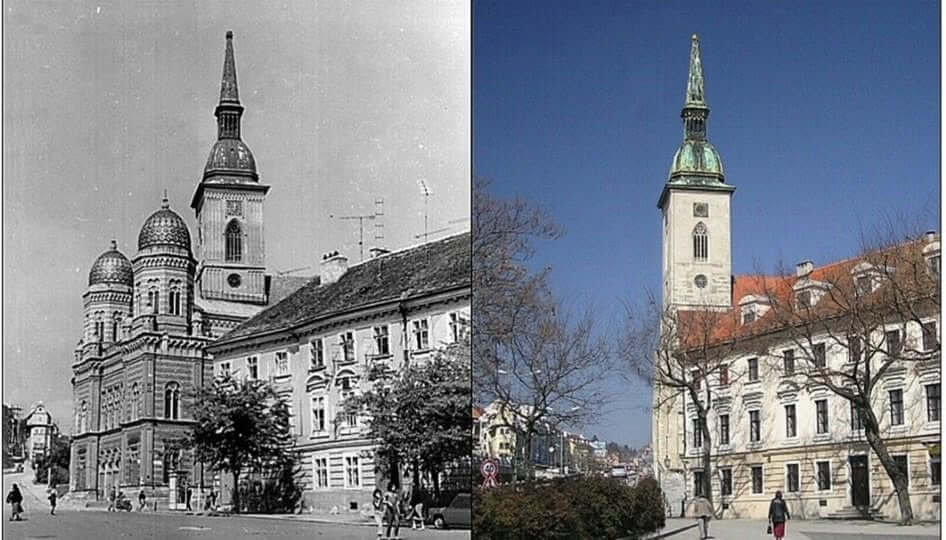
A historical photograph of the former synagogue in Bratislava, which was demolished during the communist era to make way for the construction of the SNP Bridge (Bridge of the Slovak National Uprising).
Chatam Sofer Memorial – Jewish Heritage Site in Bratislava
Jews founded their cemetery here in 1670. When in more places were available for burials, the site was covered the old graves with soil and the newly created surface served as a new cemetery. The last burial at the cemetery took place in 1847.
A decision to build a road in 1942 led to its removal. Some tombs were relocated to a new cemetery, while 23 graves of Jewish leaders were preserved at the old site and are now part of the Memorial.
Because of the danger of floods from the Danube the new road had to be raised by a few meters what required a massive layer of extra soil. The preserved part of the old Jewish cemetery with the tombs of major rabbits was covered by concrete boards. The road and later tram track passed above the site, thus making the tombs captivated in a “bunker”.
If anyone wished to visit the graves, they had to descend stairs to the underground. The site was at last reconstructed in a dignified manner between 2001 and 2002. The tram track was moved to the side in order not to pass above he underground area with the preserved tombs.
The new memorial was designed by Martin Kvasnica. Today, the unique underground Jewish cemetery with the tomb of the famed rabbi Chatam Sofer has been nominated for inclusion on the UNESCO World Cultural Heritage List. Thousands of Jews come to Bratislava to pray at the tomb. In the world of Orthodox Judaism, the memorial and the tomb of Chatam Sofer are considered one of the foremost pilgrimage sites.
Chatam Sofer, by own name Moshe Schreiber, was born on 24 September 1762 in Frankfurt. The name Sofer is Hebrew translation of the name Schreiber, meaning scribe. Chatam is acronym if his main opus Chidushei Torah Moshe, that became a breakthrough in interpretation of Talmud.
In 1806 Chatam Sofer arrived in Bratislava, on invitation the Jewish community. He remained here for 33 years until the end of life. In 1782 Jewish Patent was issued that granted religious freedom to Jews in Hungarian Kingdom. Afterwards Jews were increasingly disinclined to observe the laws of Torah. As a result of Jewish enlightenment and Reform Judaism, Chatam Sofer was comitted to guide the faithful thhorough the turmoil and chaos, and started promoting Ortodoxy in Judaism.
In 1806, Chatam Sofer arrived in Bratislava at the invitation of the Jewish community. He remained here for 33 years, until the end of his life. In 1782, the Jewish Patent was issued, granting religious freedom to Jews in the Kingdom of Hungary. Afterwards, many Jews became increasingly disinclined to observe the laws of the Torah. As a result of the Jewish Enlightenment and the emergence of Reform Judaism, Chatam Sofer was committed to guiding the faithful through this period of turmoil and change, promoting Orthodoxy in Judaism.
During his lifetime, Chatam Sofer did not allow his works to be published; they only began to appear after his death. In his lifetime he was also called “the Last of the Great Ones of the Shining Star of Israel.” Under his leadership, the yeshiva in Bratislava became the most renowned in Hungary and one of the leading institutions of European Judaism. Bratislava was proudly called the “Jerusalem of the East and Jewish Bratislava played important part in everyday life.
Jews do not bring flowers to graves. Instead, they place small pebbles and a handwritten slip of paper, folded in four and containing a prayer. Men and married women are required to wear a head covering.
Castle Street – Heart of the Jewish Quarter in Bratislava
The street is rich in legends. It used to be one of the main arteries of the Jewish ghetto. From 1863, the Orthodox synagogue, known as the Great Synagogue, stood here. It was damaged during World War II and later demolished due to structural instability. In the 20th century, much of the street was demolished, and its current development was completed in 2005, sparking major public discussions. At the lower end of the street stands a functionalist building from 1937 that houses the Jewish canteen, which for a long time was the only kosher restaurant in the city. The steps leading to Svoradova Street were named in memory of Chatam Sofer. Nearby is Zochova Street, the site of the first secular Jewish school, founded in 1820 and known as the Primarschule—another important legacy of Jewish Bratislava.
Jewish Street Bratislava – Walking Through Židovská Ulica
Virtually every Jew of Bratislava had roots on this particular street. The street, along with the adjacent area, resembled an oriental citadel. The quarter was demolished during the construction of the Slovak National Uprising Bridge (Most SNP in Slovak).
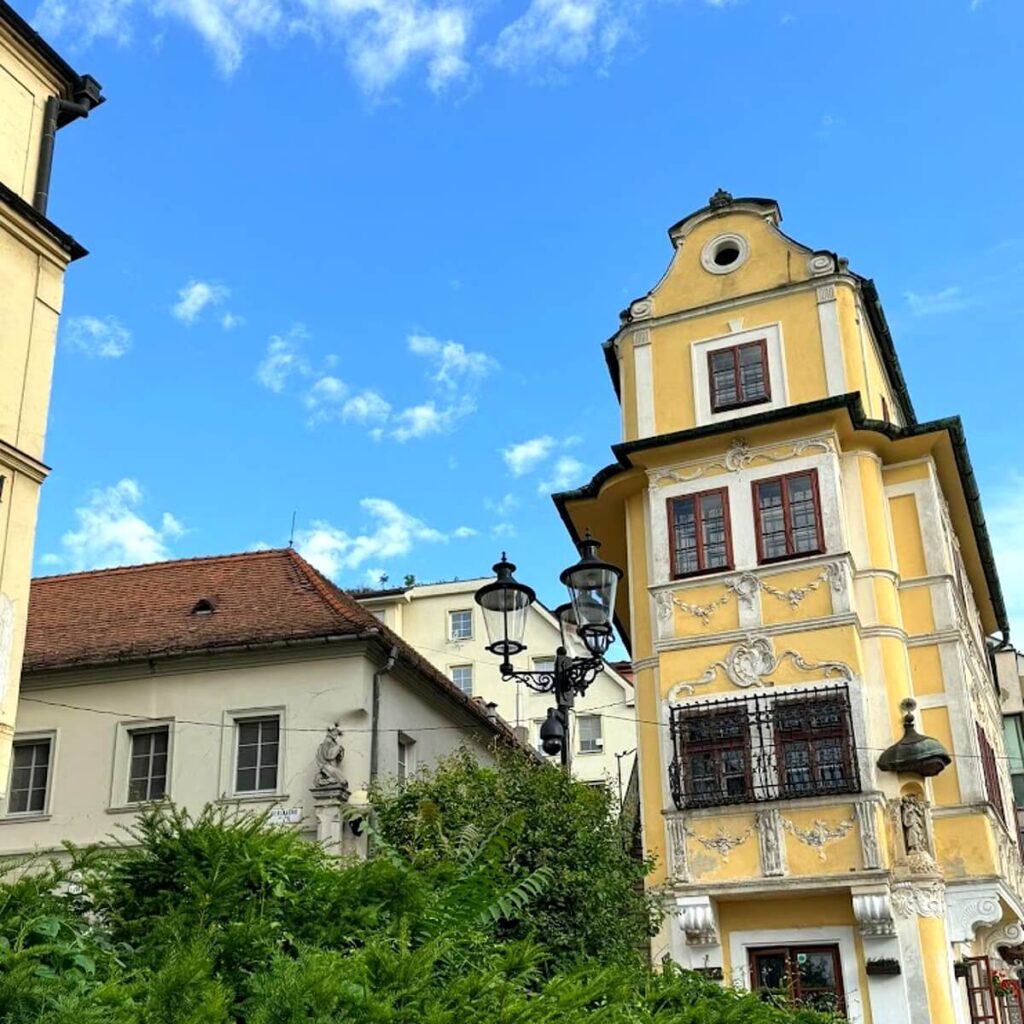
The most beautiful house of the Jewish quarter that has survived to this day is the Good Shepherd House, now home to the Museum of Clocks. Opposite it once stood the Bernauer House, with gallery balconies around the school courtyard—the Schulhof. The school housed a famous yeshiva and a public school, along with apartment blocks. For a time, it was also the site of a kosher slaughterhouse.
Lost Jewish Heritage in Bratislava – What Was Destroyed
In the southern part of Castle Hill and the square of Rybné Námestie, the local population included Jews. They had a hospital here and a synagogue, which for a time was housed in the local curia. The settlement stretched all the way to what is today Rybné Námestie, the site of the Neological Synagogue. It was devastated after World War II and used as a warehouse. Because of its excellent acoustics, it later housed a television studio, albeit only briefly. The synagogue was demolished during the construction of the SNP Bridge. It once stood just next to the prominent Roman Catholic Church, St. Martin’s Cathedral.
This contrast highlighted the cosmopolitan and tolerant nature of Bratislava in the past. Today, the Holocaust Memorial from 1997 stands on the site of the former synagogue. Behind the memorial is a wall bearing an image of the destroyed synagogue.
✡ Private Jewish Heritage Tour
Explore Jewish Bratislava with a Licensed Local Guide
Discover the hidden stories, sacred sites, and centuries of history on a private Jewish tour of Bratislava — fully customized to your interests.
🕍 Book Private Jewish TourJews are first mentioned in Bratislava’s written records as early as the 13th century, living along what is now Uršulínska Street. A city privilege granted in 1291 gave them equal status to other inhabitants — a remarkably progressive right for the era. However, their presence was never without tension. In 1526, many were expelled by Queen Mary following accusations of treason, only to be allowed back near the Castle area by the end of the 16th century.
Chatam Sofer — born Moshe Schreiber in Frankfurt in 1762 — was one of the most influential rabbis in modern Jewish history. He arrived in Bratislava in 1806 and spent the last 33 years of his life here, turning the city’s yeshiva into the most prestigious Jewish learning institution in Hungary. As Reform Judaism spread across Europe, he became Orthodoxy’s greatest defender. His tomb, preserved in an underground memorial near the Danube, is today one of the most important pilgrimage sites in the Orthodox Jewish world and has been nominated for UNESCO World Heritage status.
The historic Jewish quarter centered around Židovská (Jewish) Street was a vibrant, densely populated neighborhood described as resembling an oriental citadel. Tragically, most of it was demolished in the 1970s to make way for the construction of the Slovak National Uprising Bridge (Most SNP). The Neological Synagogue, which once stood beside St. Martin’s Cathedral, was also torn down during this period. Today, the Holocaust Memorial from 1997 marks the site where the synagogue once stood.
Yes — Bratislava is the only city in Slovakia with a living, active Jewish community. Despite the devastating losses of World War II, when Jews made up roughly 10% of the city’s population and the majority were deported to concentration camps, a community has survived and rebuilt. Today its members are involved in social services, education, and cultural life, while working to reconnect with and preserve the rich legacy of Jewish Bratislava.
A Jewish heritage walk in Bratislava takes you through layers of history in a compact area. Starting at the Chatam Sofer Memorial — an extraordinary underground cemetery — the route continues along Zámocká Street, once the heart of the Jewish ghetto and home to the demolished Great Synagogue. It passes through Židovská Street, where nearly every Bratislava Jewish family once had roots, and ends at the synagogue on Heydukova Street. Along the way, you’ll encounter the Holocaust Memorial, the Good Shepherd House, and the site of the first secular Jewish school, founded in 1820.